When analyzing the situation in which Europe currently finds itself, one can certainly draw parallels to 17th-century Europe. Severe crises—political, economic, ideological, and even religious—are dividing and threatening the countries and their inhabitants.
Compounding this today is the proliferation and influence of digital media, which further fuel people’s fears and paint dire pictures of impending catastrophe.
Just as the Chinese character for “crisis” (危機) has two meanings—namely, danger and turning point (change)—so too did the three Rosicrucian manifestos, published anonymously between 1614 and 1616, send a signal declaring that they possessed the key to timeless “secret” traditions of wisdom.
These traditions would reveal to humanity how it might “at last understand its nobility and glory, in what form it is a microcosm, and how far its art extends within nature.”
So it is written in the first paragraph of the “Fama Fraternitatis” (1614), which was addressed to “the leaders, statesmen and scholars of Europe.”
These publications caused a tremendous stir, as they promised a general reformation of the Church, the political constitution, and the sciences—everything for which people had been earnestly hoping.
“But where there is danger, there also grows that which saves!” wrote the German poet Friedrich Hölderlin in his profound hymn “Patmos” (1803).
Thus, we are faced today with the reality that the media both spread fear and terror through “fake news” and grant access to the Rosicrucians’ timeless treasure trove of wisdom. The only conditions for gaining access to it are: receptivity to spirituality, discernment, common sense, and a passion for learning.
What, then, does this Rosicrucian wisdom consist of?
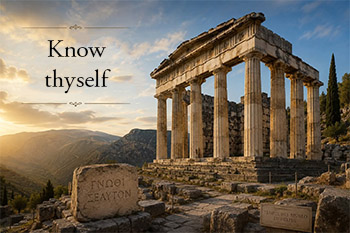
It is summed up in the motto that stood above the Temple of Apollo at Delphi in ancient Greece: The inscription read in Greek:
“Gnothi seauton!”
In English: “Know Thyself!”
According to traditional texts, however, the inscription went further and read in full: “and you will know God”!
This work of “Know Thyself” remains, to this day, the heart of Rosicrucian study. It embodies the mystical idea that the divine spark lies at the very core of the soul. Whoever fully penetrates the depths, the origin, and the limits of their own spirit also recognizes the divine principle that underlies all things. The true abyss of the soul is identical with the primordial source of God. (See Meister Eckhart, Jakob Böhme, Sufism, Vedantic philosophy)
As one draws nearer to this goal, it promises the diligent student not only personal mastery of life but—since all life constitutes a universal oneness—also a remedy for the world.