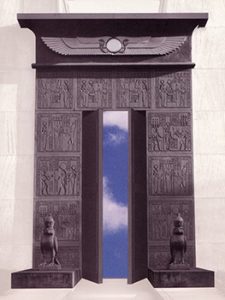
“Death is merely a door that opens onto a completely different frequency.”
The American medium Edgar Cayce (1877–1945) repeatedly emphasized this statement. He became known as the “Sleeping Prophet,” and his countless predictions across all fields remain just as relevant today as ever.
The topic of death—the Rosicrucians deliberately refer to it as “transition”—is now also being reevaluated by the natural sciences.
It began with Einstein’s famous formula E=mc2. Put simply, this states that mass and energy are one and the same. This means that our physical body can be viewed both as mass and as an energy body. The First Law of Thermodynamics can also be incorporated into these considerations.
This states that energy is never lost in a closed system—and the universe is a closed system.
Thus, we can assume that human beings, as energy beings, do not simply vanish into nothingness. They will be completely transformed. In the process, the material atoms of their bodies will disperse into earth, water, and air. His spirit-soul, on the other hand, and the information/primordial atom of his “I Am” consciousness will transition into a higher frequency or vibration. It will awaken in the spiritual world beyond space and time, endowed with all spiritual senses. There have long been countless documented experiences and research findings regarding how this transition takes place. The conclusions drawn from this: We need not fear death! It is a natural transition, a homecoming to where we came from.
A quote from the second published Rosicrucian text, “Confessio” (1615), also reinforces these statements:
“Would it not be a precious thing if you could live every hour as if you had lived from the beginning of the world until now, and were to live on even further until the end of the world!”
This means that if we consciously open ourselves to this conviction, we would be freed for all time from fear and uncertainty regarding life after death.
Furthermore, the early writings of the Rosicrucians (Fama, 1614, and Confessio, 1615) already emphasize that they possessed the true knowledge of Christ (Consciousness) and that their teachings could likewise lead those who earnestly followed them to conscious immortality—beyond time and space.
Concepts of a doctrine of the pre-existence of the spiritual soul can already be found in the creation myths of ancient peoples, such as the Egyptians, the Babylonians, and the Germanic peoples. In Eastern Buddhism and Hinduism, this belief has been part of the doctrine of karma for more than 2,000 years.
In ancient Greece, Pythagoras, Empedocles, and especially Plato (427–347 B.C.) taught that the spiritual soul had fallen from a higher sphere of existence into the material world—into its physical vessel (the body)—because of a transgression in the divine world.
Plato’s doctrine traces back to the doctrine of the soul in the Orphic Mysteries.
According to Plato, the soul exists as an “eternal idea” even before it enters the human body. After leaving the body at death, it continually seeks a new body as its dwelling place, until it once again attains that perfect “state of purity,” that high state of consciousness (Christ-consciousness), which it had previously lost.
A beautiful personal statement on the question of where we go after death was shared with us by Pope John Paul II in an address to pilgrims in 1998:
“It is a transitional phase. During this phase, the body dissolves; life continues as a spiritual entity. This entity is endowed with its own consciousness and its own will—in such a way that I—as a human being—continue to exist even though I no longer possess a body.”
May we all trust in those heavenly powers that have planned and ordained this, our respective earthly journey. And may we joyfully embrace our life plan with the conviction that we are here on earth to learn and mature, and to draw ever closer to the experience of our true self—the image of Christ within us.