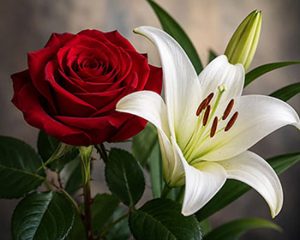
From a spiritual perspective, the entire external world is a reflection of the spiritual, heavenly world. Thus, for Rosicrucian students, the blooming red rose is the most beautiful and profound symbol of the unfolding of their consciousness toward Christ-consciousness—the goal of “Know Thyself!”
During a meditation on the rose, a “light” literally dawned on me: it is no small matter that the noble rose is hermaphroditic. The structure of the flower unites male and female reproductive organs. This flash of insight into hermaphroditism has led to many further insights into the significance of the masculine and feminine principles within us—as psychological, not biological, entities.
Therefore, I am convinced that we must increasingly turn our attention to the feminine part of our psyche that dwells within us in order to attain knowledge of the true Self, the Christ within us.
I would like to recall and reawaken the wisdom that was revered long ago under many names in various cultures as a female goddess, such as the myth of Isis among the Egyptians, the Shekhinah in Jewish mysticism, and “Holy Sophia” among the Greeks: a symbol of divine wisdom.
Even in Genesis (Old Testament), we find traces of a feminine image of God in the “Ruah,” the “Holy Spirit,” who hovered over the primeval waters and was ever present at creation.
This feminine divine principle is then also carried forward in the New Testament in connection with Jesus (especially in the Gospel of John and the Gospel of Thomas).
Thus, the Holy Spirit is also described as a maternal divine principle.
Christ, as the incarnate “Logos,” represents the male, active divine principle. The Son is conceived and born of the Virgin Mary (a symbol of perfect purity).
In Mary, however, Holy Sophia, Divine Wisdom, has become incarnate. We therefore have in Christ a divine masculine principle (Logos) and a divine feminine principle (Sophia): a wholeness and harmony of opposites.
When we contemplate the lily, we associate its white appearance with purity, innocence, and divine light. In Christianity, it is a symbol of the Virgin Mary: it is called the “Madonna lily.” This lily symbolizes the incarnation of Divine Wisdom on earth.
For the spiritual seeker who is on the path of “Know Thyself,” this means:
Only through the enlivening of Divine Sophia, the Divine Wisdom within our soul, will we attain knowledge of our true self, the Christ within us. And from this union, this “Holy Wedding” of the most excellent masculine qualities with the noblest qualities of the feminine character, arises the “new Adam,” the Son of God made man, is born.
In the third alchemical manifesto of the Rosicrucians, “The Chymical Wedding” (1616), the invitation to and celebration of this wedding (Hierogamos) of the King and the Queen is the central theme.