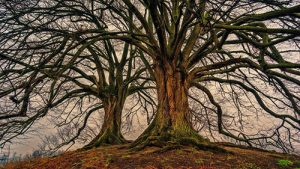
We are all likely familiar with the story of creation (Genesis 1:3).
There is the divine creation—the gift of the Garden of Eden—with its immeasurable diversity of plants, animals, fertility, and perfection.
On the last day (the sixth day of creation), the first human, Adam, is created in God’s image.
Adam, too, as a faithful image of God, is perfect, whole; all opposites are harmoniously united within him. Good and evil are separate, meaning that evil is a possibility but not active.
So that he is not alone, a companion is placed at his side, Eve, taken from one of Adam’s ribs.
Now, in the midst of this paradise (of holistic perfection), there are two trees:
The “Tree of Life” and the “Tree of the Knowledge of Good and Evil.”
In Paradise, Eve is persuaded by the serpent to eat from the fruit of the latter tree so that she and Adam might “become wise like God.”
This is a rough summary of the biblical account of the Fall and the subsequent expulsion from Paradise. But before the entrance to Paradise, it is said, “stand the cherubim with flaming swords.”
For if the two were to eat additionally from the “Tree of Life,” then the rupture between God and humanity—whose sinfulness (disobedience, the mingling of good and evil)—would last forever. Then humanity could never again return to Paradise, to the state of wholeness and perfection.
What, then, is the spiritual significance of this allegory of the two trees in Paradise?
We may recall that the “Tree of Life” (of immortality) is a millennia-old symbol spanning all ages and cultures, representing the connection between humanity and the cosmos and the eternal cycle of nature.
In Jewish mysticism, the Kabbalah, the “Tree of Life” (Etz Chajim) is the central diagram of creation. It serves as a path of spiritual development and the ascent of the human soul toward the divine.
Could the allegory of the two trees in Paradise perhaps represent two fundamental life principles of biology: the exocrine and endocrine glandular systems in 2humans? This leads to many further questions. What functions do these glandular systems serve in spiritual development? And why do Rosicrucians work with “psychic centers” rather than with the opening of the seven chakras?
First, there is the association of the “Tree of the Knowledge of Good and Evil” with the brain and nervous system (the exocrine gland system), which releases secretions via excretory ducts to the body’s outer surface.
In contrast, there is the connection between the “Tree of Life” and the cardiovascular system (the endocrine gland system). This system directs the messenger substances (hormones) directly into the blood,
There is no function in the body, no activity in the cells, including DNA replication, that is not under the direct or indirect influence of hormones. The pineal gland and pituitary gland in the brain are also essential endocrine glands that release hormones directly into the bloodstream. They play a major role in mental development.
The points of contact between the physical and the psychic world are referred to by the Rosicrucians as “psychic centers.” They are connected to the activity of certain endocrine glands.
Working with these “psychic centers” is a very gentle and lengthy process. The focus is on the physical, moral, and character purification and strengthening of the students.
It is a proven, traditional method of holistic physical and psychological development and requires no external assistance. Guidance is provided through the connection with the “inner Master” (God of our heart, God of our understanding).
In contrast, the faster, unilaterally forced activation and opening of the 7 chakras of Hindu philosophy is not without risk for the student without the assistance of a guru.
It is also interesting that the Rosicrucians speak of “12 psychic centers.”
It is said that humans in Atlantis already possessed a far more extensive energy system of 12 chakras. The 5 additional chakras (divine and multidimensional chakras) beyond the 7 chakras known today were then lost or deactivated through the misuse of these powers.
According to tradition, this is said to have led to the downfall of the Atlantean high civilization.
At the beginning of creation, we heard of a “Tree of Life,” access to which was blocked after the Fall of the first humans.
At the end of time, as it says in Revelation 22:3,
the “Tree of Life,” which bears different fruits 12 times a year, stands as the central symbol of the restored order of all creation.
It is the promise of the perfected, transformed “new” human being; a conscious return to the Garden of Eden, to wholeness, to unity with God.